Architecture
Document Fulfilment Platform
The Document Fulfilment Platform is a robust solution for managing documents from creation to distribution. It is built as a modern Angular Single Page Application (SPA) with the PrimePalette Design System. Each business function is organized into separate feature modules, making the system easier to maintain and scale. All backend communication uses secure HTTPS REST APIs, and the client side does not handle business logic or access the database directly.
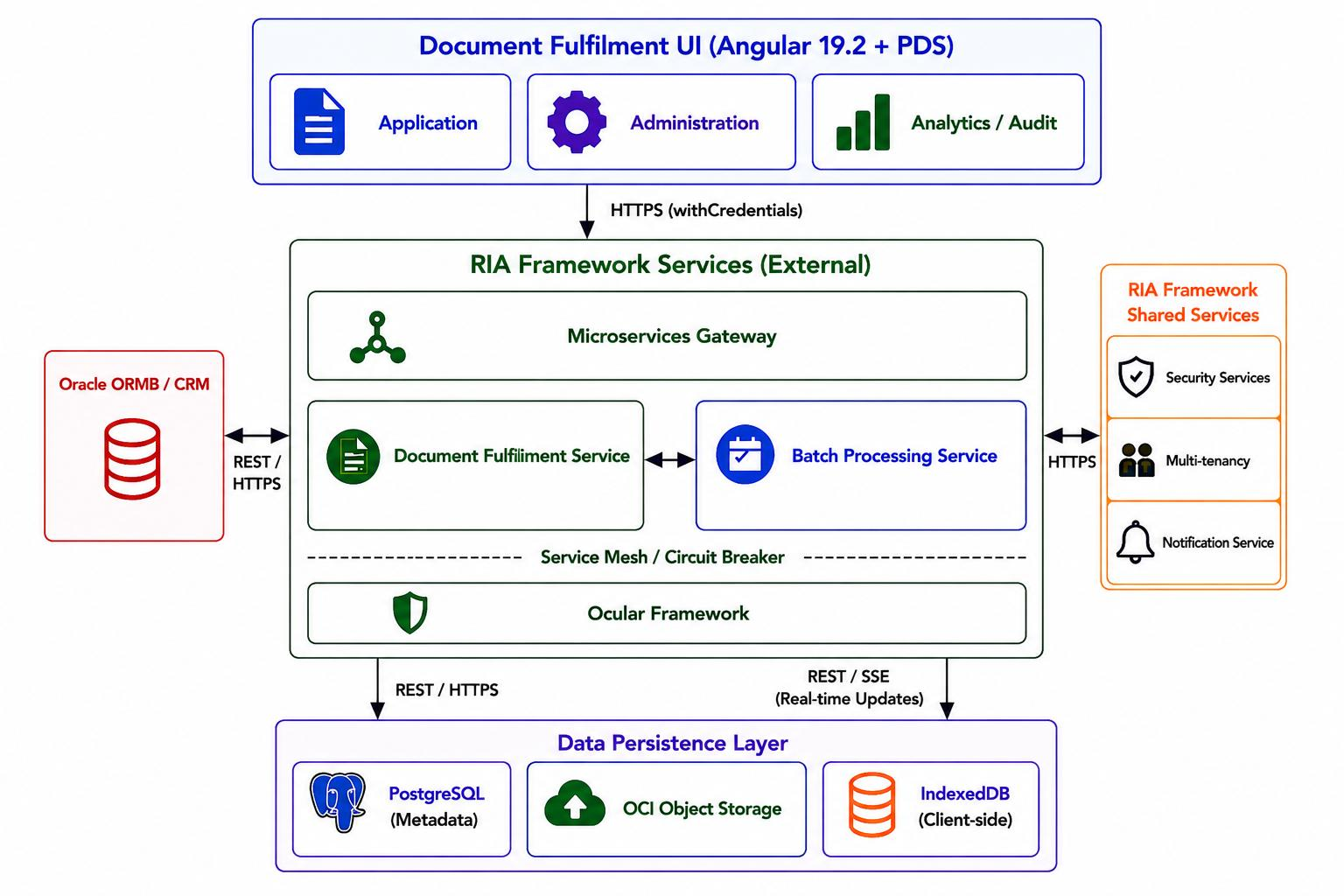
When you initiate an action through the Angular UI, the request is securely routed via the RIA Framework Microservices Gateway. The gateway authenticates and authorizes the request before forwarding it to the appropriate backend microservice. The backend retrieves business and configuration data from Oracle ORMB and PostgreSQL as needed. Documents are generated using templates, business rules, and lookups. Files are stored in OCI Object Storage. Processing status and audit logs are updated in PostgreSQL, and the Notification Service issues relevant alerts. The Angular UI then presents the results to you.
Application
The Application serves as the primary interface to create, manage, and process documents. The Documents module lets you generate, search, preview, download, and track documents in formats like PDF, DOCX, XLSX, CSV, XML, and CXML. The system stores document details, version history, and status for each document. Template management is handled through a dedicated module supporting formats including Microsoft Word, Excel, CSV, and PDF. Templates are versioned and subject to approval workflows. Configurable rules and adaptors handle business logic for choosing templates, validating data, and transforming information. These rules can be updated without redeploying the app. Product Packs group templates, rules, lookups, storage, and settings into reusable packages to simplify deployment and ensure consistency across products. The Batch Dashboard lets you monitor batch jobs in real time. It uses Server-Sent Events (SSE) for live updates, so high-volume document generation does not slow down the user experience.
Administration
Administration provides a central place to manage platform settings. The interface lets you handle reference data, storage providers, environment settings, batch schedules, and user roles and permissions. Lookup management consolidates all business reference data, which can be updated without changing code and is used in documents, rules, and workflows. Lookup Extensions let you customize values for specific tenants or customers without changing main definitions. Storage Configuration lets administrators assign storage providers, manage credentials, set retention policies, and organize directories for different environments.
Analytics / Audit
Analytics and Audit provide visibility into operations and support compliance reporting. The platform records all important events, such as user actions, document changes, configuration updates, workflow steps, and admin activities. Audit logs are stored in PostgreSQL.
RIA Framework Services
The RIA Framework is the main foundation of the Document Fulfilment Platform. It provides core microservices, security, and shared features for the enterprise.
Microservices Gateway
The Microservices Gateway handles all HTTP(S) requests at the network edge. It manages load balancing, API management, authentication, authorization, rate limiting, and monitoring.
Document Fulfilment Services
Core business logic is distributed across several microservices, each responsible for a specific domain including document template management, rule configuration and execution, lookup management, product pack orchestration, storage configuration, and audit logging. All services expose REST APIs and are designed for stateless, independent deployment. Internal modules for rules, adaptors, and lookups integrate with the Document Fulfilment Service.
Batch Processing Service
The Batch Processing Service manages large, asynchronous document generation jobs. The Batch Dashboard provides a single place to set up, schedule, monitor, and run batch jobs. The service supports parallel processing for big workloads with built-in monitoring, retry for failed records, and strong failure recovery. Real-time job updates are sent to the UI using Server-Sent Events (SSE).
Ocular Framework
Ocular Framework provides security and enterprise services across the platform. It handles authentication with tokens and SSO, and manages authorization using Role-Based Access Control (RBAC). Multi-tenancy keeps data and settings separate for each tenant. The framework also sends centralized notifications, including system alerts, job updates, workflow events, and other messages throughout the platform.
Data Persistence Layer
The platform uses a multi-layered storage system that separates business metadata, document content, and client-side caching.
PostgreSQL
PostgreSQL is the main relational database. It stores structured metadata such as templates, rules, lookups, user roles, audit logs, batch job details, and configuration.
OCI Object Storage
Large, unstructured files such as generated documents, email attachments, batch outputs, and uploaded data are stored in Oracle Cloud Infrastructure (OCI) Object Storage.
IndexedDB
To improve frontend performance, the Angular app uses IndexedDB in the browser to temporarily store lookup values, user preferences, recent settings, temporary state, and draft forms. This client-side storage lowers server load and makes the app more responsive but is not recommended for long-term business data.
Oracle ORMB/CCM Integration
The Document Fulfilment Platform connects directly with Oracle Revenue Management and Billing (ORMB) and Customer Communications Management (CCM) systems to source business data. ORMB provides customer, account, billing, and financial details needed for document generation. Data is exchanged over secure REST APIs, usually with XML or JSON. Platform adaptors convert this data into standard formats for rules and templates.
RIA Framework Shared Services
All shared services are managed within the RIA Framework. Security is handled centrally, covering authentication and authorization for every user and service. Multi-tenancy keeps tenant data and settings strictly separate, so multiple organizations or product lines can use the same deployment. The Notification Service sends timely alerts and updates about batch jobs, approvals, processing failures, and system events. Approval workflows manage the lifecycle of templates, rules, and product packs to manage configuration changes.